


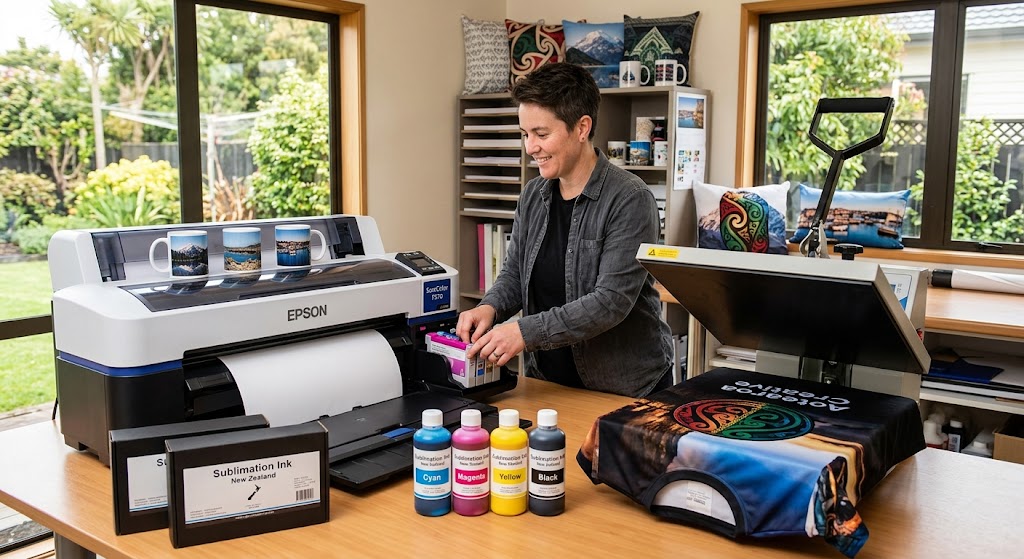
1. What is Sublimation Ink and How Does It Work in New Zealand?
Sublimation ink is a specialized dye formulation engineered to transition directly from a solid state into a gas when subjected to elevated temperatures and pressure—bypassing the liquid phase entirely. This chemical reaction, known as dye-sublimation, enables pigment molecules to bond directly into the polymers of synthetic fabrics or heat-resistant poly-coated blanks.
Unlike conventional desktop inkjet inks, which sit on top of paper fibers, sublimation ink infuses into the substrate itself. Once cooled, the gaseous dye reverts to a solid inside the fibers or coating, producing prints that resist fading, cracking, peeling, or washing out over time.
In Aotearoa New Zealand, the adoption of dye-sublimation technology has grown rapidly across diverse operational scales:
- Boutique Artisans & Crafters: Local creators rely on compact desktop setups to supply custom merchandise, regional souvenirs, and personalized gifts across local artisan markets and e-commerce stores.
- Commercial Apparel Producers: Regional textile manufacturers utilize high-volume, wide-format dye-sublimation printers to create custom sportswear, rugby jerseys, corporate apparel, and promotional merchandise.
- Industrial Signage Companies: Commercial print shops employ sublimation techniques to produce durable soft-signage, trade show displays, teardrop banners, and outdoor architectural displays designed to withstand harsh UV exposure.
2. Choosing the Right Sublimation Ink for Local Printers in NZ
Selecting the appropriate ink formulation depends heavily on your hardware architecture, color accuracy requirements, and production volume. Matching your equipment with compatible ink formulas prevents print head clogging, ensures consistent color rendering, and protects machine warranties.
Dedicated Factory Sublimation Systems
Commercial brands such as Epson SureColor (e.g., F170, F570) and Sawgrass (e.g., Virtuoso SG500, SG1000) offer turnkey solutions paired with proprietary ink systems.
- Sawgrass SubliJet-HD / Virtuoso Inks: Engineered specifically for Sawgrass piezo print heads, delivering integrated color management profiles (Virtuoso Print Manager) designed for out-of-the-box accuracy.
- Epson UltraChrome DS Inks: Formulated specifically for Epson MicroPiezo TFP print heads. These inks provide precise color matching, wash fastness, and reliable operation for high-turnaround production environments.
EcoTank Conversions and Third-Party Refillable Systems
Many New Zealand small business owners and home crafters adapt desktop tank printers (such as the Epson EcoTank series) into cost-effective sublimation engines.
- Auto-Fill Bottle Systems: Modern third-party inks feature auto-stop bottle nozzles matched to EcoTank reservoir valves, eliminating manual syringe filling and minimizing ink spills.
- Viscosity & Filtration Standards: High-grade third-party inks undergo sub-micron filtration to avoid micro-clogs in high-density print head nozzles during long idle periods.
- Anti-UV Formulations: Quality dye formulations incorporate UV inhibitors to withstand High-UV Index weather conditions in Aotearoa.
| Feature / Criteria | OEM Sealed Cartridges / Pouches | Third-Party Bulk Refill Inks |
| Compatible Hardware | Epson SureColor, Sawgrass SG series | Epson EcoTank, converted desktop units |
| Initial Investment | Higher hardware & ink consumable cost | Budget-friendly entry point |
| Color Profiles (ICC) | Pre-installed / Automatic driver sync | Custom ICC profile configuration required |
| Maintenance Needs | Automated cleaning cycles, minimal downtime | Regular test prints required to avoid clogs |
| Cost Per Milliliter | Higher cost per ml | Cost-effective bulk rate |
3. Sublimation Blank Compatibility: Polyester Fabrics to Rigid Substrates
Sublimation dye molecules bind exclusively to synthetic polymers or specialized poly-coated surfaces. Attempting to sublimate natural fibers (such as 100% cotton, wool, or linen) without an intermediary binder will result in the ink washing out completely after a single laundering cycle.
Textile and Soft Goods Applications
- 100% Polyester Apparel: Ideal for performance sportswear, activewear, and athletic jerseys where breathability and stretch retention are crucial.
- Polyester Blends (65% Poly / 35% Cotton Minimum): Produces a soft, vintage, slightly faded aesthetic due to the ink only bonding to the synthetic portion of the blend.
- Poly-Coated Canvas & Felt: Applied in interior decor, tote bags, cushion covers, and tapestry wall art.
Rigid Substrates and Coated Blanks
Rigid items must be pre-treated with a clear, heat-stable polymer coating before heat pressing:
- Ceramic Mugs & Drinkware: Sublimation-ready ceramic coffee mugs, travel tumblers, and stainless steel water bottles.
- ChromaLuxe Aluminum Panels: High-definition metal plates used for photo prints, outdoor signage, and commercial artwork.
- Engineered MDF & Coasters: Poly-coated wooden boards, placemats, keychains, and decorative plaques.
- Glassware & Acrylics: Specially coated frosted or transparent glass, cutting boards, and acrylic display blocks.
4. Masterclass Heat Press Operations: Temperature, Time, and Pressure Settings
Achieving crisp graphic transfers without ghosting, scorch marks, or color shifts requires strict adherence to heat pressing parameters. Environmental factors in New Zealand—such as ambient humidity during winter months—can affect moisture levels in transfer paper, making proper pressing technique essential.
Standard Heat Press Reference Benchmarks
- Polyester T-Shirts & Sportswear: 190°C – 200°C for 45 – 55 seconds (Medium Pressure).
- Ceramic Coffee Mugs (Mug Press / Oven Wrap): 180°C – 190°C for 180 – 210 seconds (Medium to Firm Pressure).
- Poly-Coated Stainless Steel Tumblers: 185°C – 195°C for 60 seconds, rotate 180°, press for an additional 60 seconds (Firm Pressure).
- ChromaLuxe / Metal Photo Panels: 190°C – 200°C for 60 – 80 seconds (Medium Pressure).
- MDF Wood / Hardboard Coasters: 190°C for 60 – 70 seconds (Medium Pressure).
Critical Best Practices to Prevent Transfer Flaws
- Moisture Removal Pre-Press: Always pre-press textile garments for 5–10 seconds prior to applying the transfer paper. This removes trapped atmospheric moisture, preventing steam pockets that cause uneven ink transfer or blurring.
- Heat-Resistant Tape Application: Secure transfer paper firmly to rigid blanks using high-temperature polyimide tape. Any movement during heat press opening results in “ghosting” or double images.
- Tear Paper Edges: When pressing soft apparel, gently tear the edges of the transfer paper manually rather than using a sharp paper cutter. Feathered edges eliminate harsh press lines on soft fabrics.
- Teflon / Protective Paper Layering: Place a fresh sheet of uncoated butcher paper or a Teflon sheet above and below your substrate to trap excess gaseous dye and prevent ink blow-through onto the heat platen.
5. Troubleshooting Common Sublimation Ink Issues in New Zealand
Operating sublimation equipment across changing seasonal climates introduces technical challenges. Identifying and resolving color variations or print defects quickly preserves equipment longevity and minimizes waste.
Resolving Color Mismatches (Red/Brown Blacks or Dull Blues)
- Cause: Incorrect color profile management or insufficient pressing temperatures.
- Solution: Ensure black ink reaches its required gassing temperature (typically 190°C–200°C). If blacks appear brown, reduce pressing time; if blacks appear green/yellow, increase temperature or time. Install the correct manufacturer ICC profile within your graphics software (Photoshop, Affinity Designer, or CorelDRAW) rather than letting the printer driver manage color output automatically.
Preventing and Clearing Print Head Clogging
- Cause: Infrequent printing, low room humidity, or air bubbles trapped within ink feed lines.
- Solution: Perform nozzle checks at least twice a week. If streaks occur, execute a targeted head cleaning cycle followed by a full-color CMYK purge sheet print to restore ink flow. Maintain ambient workspace humidity between 40% and 60%.
Eliminating Speckling, Spots, and Paper Smudges
- Cause: Dust particles on the substrate, static attraction, or stray wet ink on transfer paper.
- Solution: Clean rigid blanks with isopropyl alcohol and use a lint roller on fabric garments prior to pressing. Allow printed transfer sheets to dry completely before handling, especially in high-humidity coastal regions.
6. Sourcing Sublimation Inks & Supplies Across New Zealand Regions
Securing reliable, high-grade sublimation consumables within New Zealand ensures consistent production output and protects delicate piezo print head hardware.
Local Distribution and Supply Networks
- Auckland & Upper North Island: Local commercial suppliers offer bulk inks, wide-format media, and specialized textile equipment with same-day regional dispatch or trade-counter collection.
- Wellington & Central North Island: Regional distributors support educational institutes, boutique print shops, and corporate promotional businesses with short delivery turnarounds.
- Christchurch & South Island Hubs: Main distribution centers provide South Island businesses with fast freight connections for bulk inks, transfer papers, and heavy machinery parts.
Advantages of Sourcing from Local NZ Suppliers
Purchasing your sublimation supplies directly from domestic New Zealand vendors offers several key advantages over importing unverified international shipments:
- Fresh Batch Chemistries: Sublimation inks have a limited shelf life (typically 12 to 18 months). Local suppliers maintain managed stock rotation, preventing ink degradation, gelation, or print head damage.
- Fast Freight Times: Local courier networks avoid international customs holds and long shipping delays, keeping production schedules on track.
- Technical Support: Access local customer service, precise ICC profile support for native climate conditions, and local equipment troubleshooting.
- Standards Compliance: Verified local products comply with New Zealand environmental regulations, consumer guarantees, and chemical safety guidelines.
Frequently Asked Questions
Q: Can I use standard copy paper for sublimation printing in NZ?
A: No. Standard copy paper absorbs liquid ink deep into its cellulose fibers, preventing efficient dye transfer during pressing. Purpose-built dye-sublimation paper features a release coating engineered to discharge up to 95% of the printed ink onto your target substrate under heat.
Q: Can I convert any Epson printer to use sublimation ink?
A: Most Epson printers using MicroPiezo print head technology can technically utilize sublimation ink. However, once converted with non-OEM sublimation dye, factory warranties are usually voided. EcoTank series machines are widely converted due to their integrated ink reservoirs.
Q: Why do my sublimation prints look dull on paper before heat pressing?
A: Sublimation ink contains suspended dye particles that only activate and show true vibrancy when exposed to high heat and pressure. Dull, muted tones on printed transfer paper are completely normal; the full color spectrum appears after heat transfer onto the final substrate.